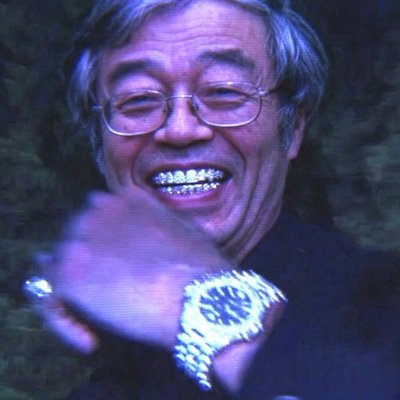
A meme-token experiment built around one strange cryptographic fact: the public key Satoshi used in Bitcoin's earliest days can be mapped to an EVM address controlled by the very same private key.
17 years of Bitcoin economics. One ancient public key. One EVM wallet waiting in plain sight.
02 / THE LEGEND
The key existed before the address.
Bitcoin started simpler than most people remember. Before the address formats we use today became standard, early transactions could pay directly to public keys. That matters because a public key is not tied to one blockchain's branding — it comes from the underlying cryptography.
2.1
Are public keys and addresses the same thing?
Not exactly. A public key is a point on an elliptic curve derived from a private key. An address is a chain-specific representation derived from that public key. Bitcoin and Ethereum package the result differently, but both ultimately rely on the same secp256k1 private-key → public-key relationship.
PRIVATE KEY→PUBLIC KEY→CHAIN-SPECIFIC ADDRESS
Different address format. Same underlying key pair.
2.2
Early Bitcoin Days
In Bitcoin's earliest era, pay-to-public-key transactions were common. Satoshi's early activity therefore left public keys visible on-chain — public information that has been preserved for more than a decade.
Once you have a valid secp256k1 public key, deriving its corresponding Ethereum-style address is deterministic. No guessing. No seed phrase. No private-key recovery. Just public cryptographic math.
03 / THE WALLET
The block 9 key.
3.1
Why block 9?
Block 9 is famous because its coinbase output was later used in the first widely recognized person-to-person Bitcoin transfer: Satoshi Nakamoto sent 10 BTC to Hal Finney. It is one of the earliest tangible examples of Satoshi exercising control over a Bitcoin private key.
Ethereum uses the same secp256k1 key-pair system. Starting from the full public key, you can derive the Ethereum address that the same private key would control on any standard EVM chain.
SATOSHI BLOCK 9 — PUBLIC KEY0411db93e1dcdb8a016b49840f8c53bc1eb68a382e97b1482ecad7b148a6909a5cb2e0eaddfb84ccf9744464f82e160bfa9b8b64f9d4c03f999b8643f656b412a3
This address is deterministically derived from the public key embedded in the block 9 coinbase output. Deriving the address does not reveal the private key.
3.3
Independent verification example — not Satoshi's key
SEPARATE TEST EXAMPLEBitcoin puzzle #135 is not connected to Satoshi or block 9.
It is used only because both its public key and private key are publicly known, allowing anyone to verify the same derivation process from end to end.
The key pair below comes from solved Bitcoin puzzle #135. It is completely unrelated to Satoshi Nakamoto, the block 9 key and the Satoshi wallet shown above. It is only an independent test example for checking the cryptographic math.
PUBLICLY DISCLOSED PUZZLE PRIVATE KEY — NOT SATOSHI'S0000000000000000000000000000006d9392a16883f90903d5f78da57af07eb2
01
Copy the unrelated puzzle public key.
02
Derive its Ethereum address.
03
Import the publicly disclosed puzzle key.
04
Confirm both produce the address shown above.
Important: this is not Satoshi's private key and it is not related to the block 9 wallet. It belongs to a separate, already solved and publicly disclosed puzzle used only as a research example. Treat it as compromised and never send funds to it. Deriving an address from a public key does not reveal or recover a private key.
04 / THE CHAIN, THE COIN & THE MISSION
Turn an old key into a new legend.
4.1
Why make a coin?
Because the wallet has been hiding in plain sight. The public information existed. The derivation existed. Yet nobody turned that idea into a culture coin whose most symbolic holder is an address tied to one of Satoshi's earliest known keys.
$CEO turns that cryptographic curiosity into a public on-chain experiment: send a fixed share of supply to the derived Satoshi wallet and leave it there — untouched unless the original private-key holder ever returns.
4.2
Why Robinhood Chain?
Because the thesis sits at the collision point of crypto and tokenized real-world assets. Robinhood's EVM direction makes the story legible: a crypto-native asset, an ancient Bitcoin key and tokenized equities living in the same environment.
Keep this section aligned with the exact launch venue, tokenization features and chain availability at launch.
4.3
Why $CEO?
The meme is simple: Bitcoin created an entirely new monetary culture. Strategy turned that culture into a public-market balance-sheet machine. $CEO sends the story back to the person who started it.
“Make Satoshi the #1 $MSTR whale — then keep the chair warm.”
The token's narrative pairs itself with tokenized $MSTR exposure. Satoshi sits at the top of the token's holder table. If the platform's holder-sharing mechanics are enabled, the idea becomes a recursive meme: the wallet associated with one of Bitcoin's earliest keys accumulating symbolic exposure to the company most identified with corporate Bitcoin.
4.4
The forbidden flywheel
BITCOIN
→
STRATEGY
→
$MSTR
→
$CEO
→
SATOSHI WALLET
Not a roadmap. Not a promise. A meme with a cryptographic anchor: build the largest possible symbolic $MSTR position around a wallet that only Satoshi's original private key could control, and let the internet write the rest of the story.
THE END / OR THE BEGINNING
The wallet is already there.
The only question is whether its owner ever comes back.
$CEO is a meme token and experimental on-chain project. Nothing on this site is financial advice or a promise of value, yield, equity ownership or future returns. References to Satoshi Nakamoto, Robinhood, Strategy, MSTR and Michael Saylor are cultural/narrative references only; the project is not affiliated with or endorsed by them.